
About
Santiago Veros
The composer who helps choirs grow
Santiago Veros (Buenos Aires, 1990) is an internationally acclaimed Argentine choral composer and conductor. Known for sophisticated contemporary choral writing grounded in vocal awareness, he creates works that help ensembles expand sound, technique, and expressive range. His catalog provides directors with fresh repertoire that is artistically meaningful and realistically achievable.
Santiago’s current practice centers on strengthening choral communities through collaborative creation. He leads annual international consortiums, develops guest-composer residencies and tours with universities and ensembles, and contributes to festivals where new music becomes a shared narrative rather than a standalone piece. He personally supervises the publication of his works with a singer and conductor focused editorial approach, and is expanding accessibility through QR-linked learning tools.
His work is present on every continent, with documented collaborations across at least 57 U.S. university programs. He writes for major institutions such as the National Polyphonic Choir of Argentina and believes that artistic excellence and collective growth thrive together.
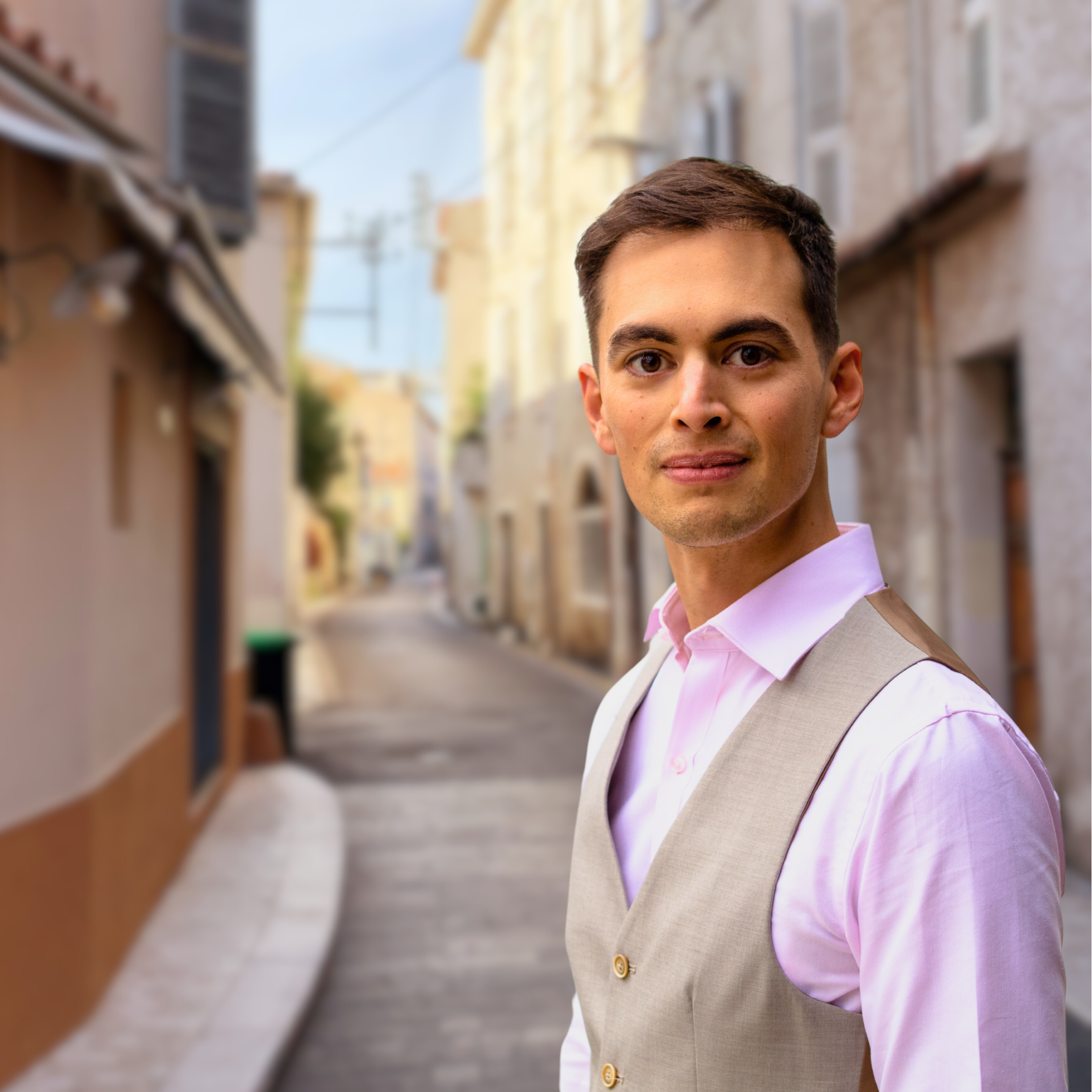
“I write for choirs because the choir is the only living instrument, and part of living is to explore and grow.”
Life Timeline
From early curiosity to a global choir-growth practice
A clear arc from family roots and voice-centered training to international strategy, major collaborations, and a long-term vision where new repertoire becomes a reliable engine for artistic growth.
Born in Caseros, in the Buenos Aires conurbano, Santiago grows up in a working, intellectually active home. His father is a musician and music therapist, and his mother a sociologist. Surrounded by rhythm, listening, and social awareness, he begins exploring instruments at age four, long before any formal training.
He begins lessons with Valeria Pelka while simultaneously exploring the voice to address his own speech challenges. This dual path gradually forges a musician who understands the vocal apparatus from lived experience, not theory alone. The foundation of his future identity emerges here: writing that respects the living instrument and makes growth feel achievable.
Santiago studies Composition at the National University of La Plata. During these years he recognizes his talent for combining voice and music into a single expressive system. In December 2009 he writes Almas de Barro, a work that later becomes his first bestseller and a defining example of direct emotional storytelling.
After graduating, he enters a demanding five-year stretch focused on building a viable international path from a local context where living from composition seemed unrealistic. Early premieres in places such as the Philippines and Chile, the disciplined use of social media, and relentless outreach become part of a single goal: earning a place for his voice beyond borders.
The World Symposium on Choral Music in Barcelona becomes the turning point. With limited resources and without fluent English, Santiago attends with a loan from his mother, who sets a clear condition: schedule 100 meetings with directors and publishers. He exceeds the target, completing 115 meetings in ten days, supported by colleagues such as Jake Runestad. The result is immediate momentum. Soon after, Cantala (USA), led by Phillip Swan, records O Magnum Mysterium, and his name begins to circulate globally as a composer of vocal intelligence and emotional impact.
Visibility expands quickly. In 2018 he becomes the first Latin American composer to premiere a work at Europa Cantat in Tallinn, and his music gains presence in major professional and academic spaces. In 2019 he travels to Europe leading concerts and workshops. By 2020 he appears in person in Rochester, NY for ACDA, presenting Human, a bold artistic denunciation that confirms his commitment to emotionally responsible storytelling.
The pandemic years bring creation under extreme conditions. In December 2020 Santiago suffers an internal hemorrhage that leads to intensive care. Recovery reshapes his sense of purpose. Between December 2020 and February 2021 he writes Galaxias, a spiritual statement about unique human light, long-distance connection, and the urgency of living fully.
Early in the year, Santiago releases Lake of Stars in collaboration with Elektra Women’s Choir and musicians from the Vancouver Simphony Orchestra. He then begins an extended touring period across Europe and the United States centered on premieres of I Will Dream With You, a collaboration with Anthony Silvestri about loss, remembrance, and human support.
After returning to Buenos Aires and sensing the need for renewal, Santiago closes his apartment, stores his belongings, and adopts a nomadic rhythm focused on visiting choirs, leading workshops, and composing on the move. He completes major projects such as Glaciares and expands his long-form vision. He announces a collaboration with the National Choir of Argentina for Amigos Míos and closes the period with the launch of Odes of Love. By this stage, he has collaborated with 57 U.S. university programs and his music is present on every continent.
Artistic Purpose
Mission, vision, and the choir-first mindset
A practical framework that helps directors understand what Santiago stands for and why his work strengthens ensembles artistically, vocally, and culturally.
Artistic growth with real human impact
As a full-time academic composer, Santiago’s mission is to generate well-being, artistic growth, and meaningful human connection through choral music. He believes every choir deserves to sing a piece that reflects its identity, and every person deserves to feel represented in the art they perform.
He strives to create music that is emotionally resonant, socially inclusive, and artistically lasting, works that build bridges between people and help choirs find their voice.
A globally connected choral ecosystem
Santiago’s vision is to build a global, interconnected choral community through collaborative creation and artistic excellence. He aims to position his work on the world’s most meaningful stages, connect choirs across countries through consortia and residencies, and open doors for underrepresented voices using music as a platform for inclusion, beauty, and transformation.
Excellence, inclusion, connection, growth
Santiago feels a responsibility to leave something meaningful behind, works that spark reflection, expand awareness, and honor shared humanity. He believes art is a fundamental human right that belongs to everyone, regardless of background or circumstance.
Excellence
Excellence allows the message to endure. What is crafted with care can resonate deeply and stand the test of time. Through excellence, Santiago builds art that matters emotionally, artistically, and socially.
Inclusion
Inclusion brings us closer to our humanity. Music should be a space where every voice can belong. By embracing diverse identities and perspectives, choirs become more compassionate, empathetic, and just.
Connection
Connection is at the heart of Santiago’s work. When singers feel seen, heard, and challenged, they become better able to connect with others. This is how choirs transform into communities.
Growth
Growth is not an abstract slogan in his catalog. It is a measurable artistic outcome. His writing helps ensembles expand technique and expressive range without sacrificing vocal health or realistic rehearsal demands.
Strategic Planning
How Santiago builds long-term value for choirs
A yearly ecosystem of initiatives designed to strengthen choral connections, expand access to meaningful new repertoire, and help directors deliver high-impact outcomes.
Choral consortiums
Each year, Santiago offers at least one international consortium open to choirs worldwide. These initiatives allow ensembles to co-commission a work, build community, and share a premiere across borders.
- Shared artistic ownership and recognition.
- Financially intelligent access to new repertoire.
- Premieres that feel communal, not isolated.
Guest composer tours and residencies
He organizes visits as a composer-in-residence, combining clinics, rehearsals, workshops, and performances. These exchanges often lead to lasting relationships and clear educational impact.
- Direct rehearsal-room insight for your singers.
- Program design aligned with your season goals.
- Measurable growth in sound and confidence.
Festival engagement and storVancouver Orchestraytelling
Santiago participates in international festivals as a guest composer or jury member, often supporting musical storytelling and collective expression. New music becomes part of a narrative that audiences can feel and remember.
- Works that serve the festival’s identity.
- Workshops on collaborative creation.
- Repertoire with cultural and emotional clarity.
Curated editions and accessibility tools
He personally oversees the editing and publishing of his works with support from collaborators such as Micaela Carballo and Valeria Pelka. These editions prioritize musical detail and user experience.
- Clear rehearsal-friendly layout decisions.
- QR-linked audio resources in development.
- Support for ensembles with limited sight-reading time.
Strategic artistic planning
Santiago collaborates with institutions to co-design initiatives aligned with their artistic goals, from commission planning to community-focused premieres. The priority is sustainability and meaning.
- Flexible scope based on your ensemble’s reality.
- Clear value for audiences and stakeholders.
- Long-term repertoire return on investment.
High-impact milestones
These efforts connect to major upcoming moments, including the world premiere of Dear Earth at Carnegie Hall in April 2026 with the New England Symphonic Ensemble, and a new consortium piece for the National Polyphonic Choir of Argentina, set to premiere in October 2025.
- Institutional credibility for commissioning.
- Global visibility tied to meaningful narratives.
- Artistic growth with international context.
These initiatives serve a single long-term objective: to create music that unites people, amplifies artistic excellence, and helps choirs grow across borders and cultures.
- Repertoire that remains useful beyond the premiere window.
- Projects that strengthen community and institutional pride.
- Vocal-first writing that protects and elevates real singers.